Updated:
On this page
This crypto glossary is written for people who meet crypto from a Cape Verdean starting point: a nomad on Sal being paid in USDT, a retiree in Mindelo curious about Bitcoin, a family in Boston sending money home to Fogo. The full A to Z list sits at the bottom of the page. Above it, the terms are grouped by what you are trying to do, because “spread” makes more sense next to “slippage”, and “seed phrase” next to “private key”.
First, the word itself. Crypto, short for cryptocurrency, means digital value recorded on a public network of computers, the blockchain, which no single company or government runs. There is no bank holding your balance; whoever has the private key to an address can move what is in it. Holding crypto is legal in Cape Verde, but it is not legal tender, so no shop has to accept it and the Banco de Cabo Verde does not guarantee its value, a point the central bank made in its warning of 29 March 2018.
Buying and selling terms
An exchange is the platform where you buy and sell crypto: Binance, Kraken, CEX.IO and others. Before you can deposit, it runs KYC“Know Your Customer”: the exchange asks for an ID, a selfie and sometimes proof of address before you can deposit. Glossary checks, usually a passport photo and a selfie. Then you can either use a simple “buy” screen, which shows one all-in price, or trade on the spot market against other users through the order book, the live list of buy and sell offers.
Spot trading fees come in two flavours. A maker places an order that waits in the book; a taker fills an order that is already there and normally pays more. On Kraken Pro’s entry tier, for instance, that is 0.40% for makers and 0.80% for takers, so on a €200 purchase the difference is 80 cents versus €1.60.
P2P (peer-to-peer) means buying directly from another user. You pay them in escudos or euros and the platform releases crypto it was holding in EscrowThe platform locks the seller’s crypto until the buyer pays. It protects both sides in P2P. Glossary, which protects both sides while the payment clears. On the big exchanges it is the only place the escudo shows up at all; our P2P guide for Cape Verde shows how thin that market actually is.
Card purchases add two more words. 3-D Secure is your bank’s extra confirmation step by SMS or app, and many exchanges refuse cards without it. A ChargebackAsking your bank to reverse a payment. In P2P, scammers use it to claw money back after receiving the crypto. Glossary is asking your bank to reverse a payment; in P2P, fraudsters use it to claw back their money after the crypto has been released. OTC desks handle large trades directly with the exchange, outside the order book. Which local cards work at all is covered in the Vinti4 and Visa card guide.
Spread and slippage, worked through
Neither of these shows up on a fee line, which is exactly why it pays to see them once with real numbers.
The SpreadThe gap between the buy price and the sell price. A hidden cost, even when the advertised fee is zero. Glossary is the gap between what you pay to buy and what you would get if you sold at the same moment. The figures below come from live ads collected on 16 November 2026, compared with a reference rate of about 99.77 escudos per US dollar (ECB rate of 13 November 2026).
| Situation | Escudos per USDT | 250 USDT is worth | Versus reference |
|---|---|---|---|
| Reference rate | 99.77 CVE | 24,943 CVE | — |
| Best Binance P2P bid | 93.00 CVE | 23,250 CVE | −6.8% |
| Lowest Binance P2P bid | 80.04 CVE | 20,010 CVE | −19.8% |
| LocalCoinSwap sell offer | 129.90 CVE | 32,475 CVE | +30.2% |
So a freelancer cashing out 250 USDT through the best escudo bid available that morning would have received about 1,690 escudos (roughly €15) less than the reference value, with no “fee” in sight. And an offer priced 30% above the market is a warning sign, not a deal.
SlippageWhen your order fills at a worse price than the one shown, because the price moved or there was not enough volume. Glossary is the gap between the price on screen and the average price your order actually fills at. It bites when the order book is thin or the market is moving fast. An illustrative example: you place a market order for €500 of a small, lightly traded coin. The top offers cover only half of it, the rest fills at progressively worse prices, and your average ends up 1.5% above what you saw. That is €7.50 you did not plan to pay. On BTC or USDT at these sizes, slippage is usually negligible; on obscure tokens it is not. Limit orders and coins with deep markets are the fix, which is one reason our coin rankings for Cape Verde weigh liquidity so heavily.
Know what you are paying?
Check the final amount of crypto you receive, not just the headline fee, on an exchange that accepts cards issued in Cape Verde.
Security terms
Your Seed phrase12 or 24 words that give full control of a wallet. Whoever holds them controls the funds; lose them with no copy and the funds are gone. Glossary is the 12 or 24 words that can rebuild your wallet anywhere. It generates your private keys, the secret codes that sign every transaction. Anyone who reads the words owns the funds.
A custodial wallet means a company holds the keys, as an exchange does; non-custodial means only you do. A hot wallet lives in an internet-connected app, while cold storage keeps keys offline, typically on a hardware wallet. Our guide to crypto wallets in Cape Verde covers which brands will actually deliver to the islands.
2FA is the second code you enter after your password; use an authenticator app rather than SMS. Proof of reserves is an exchange’s report showing it holds customers’ crypto one for one. And a Ponzi scheme pays “returns” to early members out of newer members’ money until the inflow stops. Cape Verde has seen one close up: “WS Investimentos” was sold as a crypto investment promising two to four times your money in a month, from 50,000 escudos, and collapsed. The warning signs are in our crypto scams guide.
Network terms
The blockchain is the shared public ledger of every transaction. A NetworkThe “road” crypto travels on: TRC20 (Tron), ERC20 (Ethereum), BEP20, Solana. Sender and receiver must use the same one. Glossary is the road a token travels on, and the same USDT runs on TRC20 (Tron), ERC20 (Ethereum), BEP20 (BNB Smart Chain) and Solana. Sender and receiver must use the same one. An address is crypto’s equivalent of an IBAN, a long string you always copy and paste. Some coins, XRP being the usual example, also need a memo or tag on exchange deposits.
Gas, or the network fee, is what you pay the network to process a transaction; it can be steep on Ethereum at busy times and is usually small on Tron or Solana. A nonce is a “number used once”. On Ethereum it counts how many transactions an address has sent, so they are processed in order and cannot be replayed; in Bitcoin mining, it is the number miners keep changing while searching for a valid block. A halving cuts Bitcoin miners’ reward in half, roughly every four years.
Two last words about price. A stablecoin tracks an ordinary currency: USDT and USDC follow the dollar, EURC the euro. Volatility describes how far and how fast a price swings; Bitcoin can move 5% to 10% in a day, a stablecoin barely at all.
Terms you will only meet in Cape Verde
Some words no foreign glossary covers, yet they shape how crypto works on the islands.
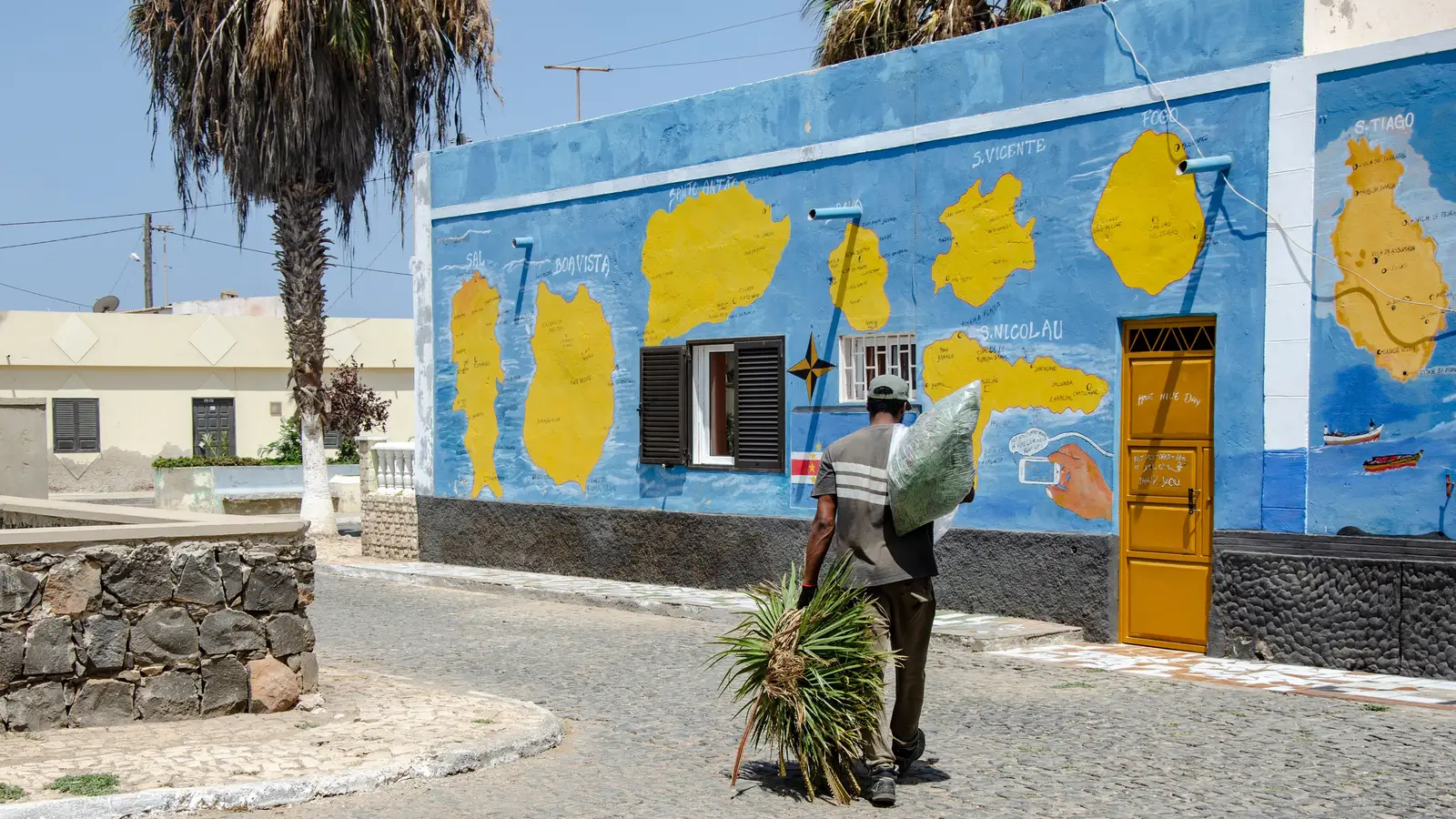
The escudo (CVE) is tied to the euro by a Fixed pegAn exchange rate fixed by agreement. One escudo is always worth 1/110.265 of a euro. Glossary: €1 is always 110.265 escudos, as it has been since 1999 under the exchange cooperation agreement signed with Portugal on 13 March 1998. For a tourist on Sal paying in euros, that means a fair conversion is always the same number, even if some shops round it to 100. For crypto, it means a euro price converts to escudos without surprises, while a dollar price shifts with the euro-dollar rate. More in our guide to the escudo, the euro and crypto. You will also hear contos: one conto is 1,000 escudos, so “fifty contos” is 50,000 CVE, about €453.
The BCV, Banco de Cabo Verde, is the central bank and foreign-exchange authority. Under Law 30/X/2023 it also supervises VASPs (virtual-asset service providers, sometimes written PSAV in Portuguese): any firm exchanging, holding or transferring crypto professionally in Cape Verde must register with it first. We found no public register of registered firms. The central bank guide has the detail.
SISP runs the national payments network, and Vinti4 is its national debit card: 233 cash machines across all the islands, more than 381,000 cardholders and about 14,000 payment terminals. Vinti4 does not pay foreign websites, so it cannot fund an exchange account. Local banks also issue Visa and Mastercard cards that work online. International bank transfers go by SWIFT, because Cape Verde is outside the SEPA zone; a Cape Verdean IBAN has 25 characters.
| Local term | What it is | Why it matters for crypto |
|---|---|---|
| Vinti4 | National debit card run by SISP | Will not pay foreign exchanges |
| Peg | €1 = 110.265 CVE, fixed | Euro prices convert without FX risk |
| Contos | 1 conto = 1,000 escudos | Common shorthand in ads and chat |
| VASP / PSAV | Crypto service provider | Must register with the BCV first |
One more is still only on paper: CBDC, a central bank digital currency. The BCV’s new organic law, Law 70/X/2026 of 26 January, allows it to issue money “in physical, digital or other format”, but no digital escudo has been issued.
The full A to Z list
Every term we use across the site, in alphabetical order. Each entry has its own anchor, so you can share a link straight to one definition.
- 2FA
- A second code, from an app such as Google Authenticator, on top of your password. Prefer an app to SMS.
- 3-D Secure
- The extra check your bank asks for in an online card payment (SMS or app code). Many exchanges refuse cards without it.
- Address
- The crypto “IBAN”: a long string of letters and numbers you send to. Always copy and paste it, never type it.
- CBDC
- Digital money issued by the central bank itself, as a “digital escudo” would be. Not a free-floating cryptocurrency.
- Chargeback
- Asking your bank to reverse a payment. In P2P, scammers use it to claw money back after receiving the crypto.
- Cold storage
- Keeping crypto on a device that never touches the internet, such as a hardware wallet. Much harder to hack.
- Custodial
- The exchange holds the keys for you, like a bank holds your balance. Convenient, but you rely on the company.
- Escrow
- The platform locks the seller’s crypto until the buyer pays. It protects both sides in P2P.
- Fixed peg
- An exchange rate fixed by agreement. One escudo is always worth 1/110.265 of a euro.
- Gas / network fee
- What you pay the network to process a transaction. High on Ethereum at busy times, usually low on Tron or Solana.
- Halving
- The cut in half of Bitcoin miners’ reward, roughly every four years.
- Hardware wallet
- A small physical device that keeps your private keys away from your phone and computer.
- Hot wallet
- A wallet in an internet-connected app. Handy for daily use, more exposed to malware and scams.
- KYC
- “Know Your Customer”: the exchange asks for an ID, a selfie and sometimes proof of address before you can deposit.
- Maker / taker
- A maker leaves an order waiting in the book; a taker fills an order already there. Takers usually pay more.
- Memo / tag
- An extra code some networks (XRP, for example) need on a deposit so the exchange knows whose money it is.
- Network
- The “road” crypto travels on: TRC20 (Tron), ERC20 (Ethereum), BEP20, Solana. Sender and receiver must use the same one.
- Non-custodial
- Only you hold the keys. Nobody can freeze the funds, and nobody can recover them if you lose the seed.
- Order book
- The list of buy and sell offers on an exchange, with prices and amounts.
- OTC
- Trading large amounts outside the order book, directly with an exchange desk, to avoid slippage.
- P2P (peer-to-peer)
- Buying directly from another person: you pay them in escudos or euros and the platform releases the crypto it was holding.
- Ponzi scheme
- Pays “profits” to early members with money from new ones. It collapses when new money stops coming in.
- Private key
- The secret code that signs transactions. A seed phrase generates all the private keys of a wallet.
- Proof of reserves
- A report in which an exchange shows it holds its customers’ crypto one to one.
- Seed phrase
- 12 or 24 words that give full control of a wallet. Whoever holds them controls the funds; lose them with no copy and the funds are gone.
- SEPA
- Europe’s euro transfer system. Cheap and fast, but only for accounts in SEPA countries.
- Slippage
- When your order fills at a worse price than the one shown, because the price moved or there was not enough volume.
- Spread
- The gap between the buy price and the sell price. A hidden cost, even when the advertised fee is zero.
- Stablecoin
- A crypto token tied to a regular currency such as the dollar (USDT, USDC) or the euro (EURC), so its price stays steady.
- SWIFT
- The network for international bank transfers. Cape Verdean banks use it because they are outside the SEPA zone.
- Virtual-asset service provider (VASP)
- A business that exchanges, holds or transfers crypto for clients. In Cape Verde it must register with the central bank.
- Volatility
- How much and how fast a price moves. Bitcoin can move 5–10% in a day.
If you came here to unblock a next step, the usual ones are setting up a crypto wallet, comparing the best crypto exchanges in Cape Verde or checking which coins are easiest to buy and sell from the islands. We add to this crypto glossary whenever a new guide introduces a term.
Frequently asked questions
What does crypto actually mean?
Crypto is short for cryptocurrency: a record of value on a public network of computers that no single party controls. Whoever holds the private key to an address can move what is in it. In Cape Verde holding crypto is legal, but it is not legal tender, so no shop has to accept it and the central bank does not stand behind its value.
What is a seed phrase?
It is the list of 12 or 24 words your wallet shows when you create it. Those words can rebuild the wallet on any device, so whoever has them controls the funds. Write them down by hand, keep them dry and never photograph or share them. Our wallet guide covers storage.
What is slippage?
Slippage is the gap between the price you saw when you placed an order and the average price you actually got. It happens when the order book is thin or the price moves quickly. Limit orders and sticking to heavily traded coins keep it small.
What is a nonce in crypto?
A nonce is a number used once. On Ethereum and similar networks it counts the transactions sent from an address, so they are processed in order and cannot be replayed. In Bitcoin mining it is the number miners keep changing while searching for a valid block. You rarely need to touch it.
What is a stablecoin and why does the euro peg matter?
A stablecoin tracks a normal currency: USDT and USDC follow the US dollar, EURC follows the euro. Because the escudo is fixed at 110.265 to the euro, one EURC stays close to that many escudos, while USDT priced in escudos moves with the euro-dollar rate.
What is a VASP in Cape Verde?
A virtual-asset service provider: a business that exchanges, holds or transfers crypto for clients. Under Law 30/X/2023 any firm doing this professionally in Cape Verde must register with the Banco de Cabo Verde first. We found no public register of registered firms.