






If you want to buy crypto in Cape Verde, the short version is this: it is legal, it works, and almost none of the usual European shortcuts apply. There is no local exchange and no Bitcoin ATM, the Vinti4 card that every resident carries will not pay a foreign website, and Cape Verdean banks sit outside the SEPA zone. What does work is a Visa or Mastercard from a local bank, an international exchange that accepts Cape Verde residents, and a clear idea of the fees. Everything below was checked against official pages, with worked examples in escudos and euros.
How we tested the best crypto exchanges in Cape Verde
The ranking above is not a list borrowed from another country with the flag swapped. On 16 November 2026 we read the official pages of ten exchanges one by one: terms of use, restricted-country lists, fee and limit pages, the lists of countries where cards are refused, and the public P2P endpoints where they exist. We asked the same question each time. Can someone living in Praia, Mindelo or Espargos open an account, get money in and get it back out again?
The criteria, in order of weight, were: whether the terms accept Cape Verde residents; whether there is a real way to fund the account from the islands (card, SWIFT or escudo P2P); whether fees are published and checkable; whether the legal entity is named, with its registrations; and finally language and support. An exchange that hides its fees until the last screen loses marks even if the final number is low. The full method is on our editorial policy page, and the fees sit side by side on the exchange fee comparison.
Why CEX.IO comes first
CEX.IO is not the cheapest option in every scenario. It earns first place because it solves the main problem for anyone living here: paying with a card issued in Cape Verde. On the CEX.IO limits and commissions page, Cape Verde appears on none of the three lists of countries where cards are refused, whether for deposits, Visa withdrawals or Mastercard withdrawals. Guinea-Bissau, for comparison, is on them. Card deposits cost 0.49% to 4.99% plus a service charge, and withdrawals back to the card carry the same percentage.
A few other details matter. The company has been running since 2013, its Portuguese site is written in European rather than Brazilian Portuguese, and international customers contract with CEX OVRS LLC, registered in St Kitts and Nevis. Other group entities hold a UK FCA registration (FRN 1007192) and a US FinCEN MSB registration (NMLS 1804170). To be clear, CEX.IO is not registered in Cape Verde as far as we know, and no international exchange appears on a public central-bank register, because no such public register exists. The weak points are just as specific: new accounts are capped at US$1,000 a day and US$3,000 a month for the first three months, there is no SEPA for Cape Verdean accounts, and there is no P2P. Our CEX.IO review has the full picture.
Binance takes second place for a different reason. It is the only major exchange with escudos on P2P, though the Binance review explains why that market is far thinner than it sounds.
Start with the shortest route
Open an account on an exchange that accepts Visa cards issued in Cape Verde, and buy from about 20 dollars.
Quickest way to buy crypto from Cape Verde
For most residents, the route measured in minutes rather than days is the card route. It is the same whether you want Bitcoin or a stablecoin; the guides to buying Bitcoin and buying USDT cover coin-specific details. Here it is in four steps:
Get a Visa or Mastercard from your bank
At BCA, Caixa, BCN or another local bank, ask for a Visa or Mastercard that works online. A prepaid card is fine. Check at the branch that payments to foreign websites are switched on and what the bank charges for currency conversion, because that is where its fee hides. Banks do not publish card prices in one consistent place, so ask.
Sign up and verify
Register with your email and complete KYC (verificação de identidade)“Know Your Customer”: a exchange pede documento, selfie e por vezes comprovativo de morada antes de deixar depositar. Glossário with your passport or national ID card. Switch on 2FA (dupla autenticação)Um segundo código, de uma app como o Google Authenticator, além da palavra-passe. Prefira app a SMS. Glossário straight away; it is the cheapest protection you will ever buy.
Fund with the card
Choose the amount in dollars or euros. Your bank will usually ask for a 3-D SecureConfirmação extra do banco (código por SMS ou app) num pagamento online com cartão. Sem ela muitas exchanges recusam o cartão. Glossário confirmation by app or text message. Keep the first payment small, say 5,000 or 10,000 escudos, so you can see exactly what both the bank and the exchange take.
Buy, then decide where to keep it
Buy the coin you want and decide whether it stays on the exchange or moves to your own wallet. For anything you plan to hold for months, read the crypto wallets guide before you withdraw.
A worked example: say you put in 55,132 escudos, which is €500 at the fixed peg. At CEX.IO’s card fee of 0.49% to 4.99%, you would pay roughly 270 to 2,750 escudos, plus the service charge and whatever your bank adds for a foreign payment. The 0.25% trading fee at the entry tier comes after that. Run one real test with your own card before moving larger sums.

Vinti4, Visa and bank wires: which payment works where
Most people start with the card already in their wallet, which in Cape Verde is usually Vinti4. SISP calls it the national card: more than 381,000 cardholders, 233 cash machines across every island and about 14,000 payment terminals. It is perfect for the supermarket in Palmarejo or a cash withdrawal in Sal Rei. It simply does not pay foreign websites, and no international exchange accepts it.
The same banks also issue Visa and Mastercard cards (prepaid, Electron, Classic, Gold) which, according to SISP, work for online shopping and in more than 210 countries. That is the card that unlocks exchanges. Our Vinti4 vs Visa card guide explains the card types and what to ask at the branch.
For larger amounts there is the bank wire, with one catch that surprises newcomers from Europe: Cape Verde is not in the SEPASistema de transferências em euros da Europa. Barato e rápido, mas só para contas em países SEPA. Glossário zone. A Cape Verdean IBAN is 25 characters long and looks European, but international transfers leave by SWIFTRede de transferências bancárias internacionais. É a usada pelos bancos de Cabo Verde, que não estão na zona SEPA. Glossário, with a fee from your bank and often from an intermediary bank as well. No exchange accepts SEPA from a Cape Verdean bank. Crypto.com names Cape Verde in writing among the countries eligible for USD SWIFT: free deposits on its side with a US$1 minimum, but a US$45 withdrawal fee with a US$500 minimum. Kraken accepts USD SWIFT with a US$100 minimum. Our banks and crypto guide walks through the transfer itself.
If you are a digital nomad or expat whose salary lands in a European account, the picture changes: a SEPA transfer from that home account is usually the cheaper way to fund an exchange account opened in your home country. The digital nomads guide covers that set-up.
| Your situation | Best route | Timing | What it costs |
|---|---|---|---|
| First purchase, under US$1,000 | Visa/Mastercard | Minutes | 0.49%–4.99% + bank FX |
| Large amount, no rush | USD SWIFT | 1–5 business days | Your bank’s SWIFT fee |
| Selling USDT for escudos | Binance P2P | Hours | 7%–20% below official rate |
| Family abroad sending money | Compare remittances | Varies | Check Wise and WU first |
P2P with escudos: what exists today
P2P (pessoa a pessoa)Compra direta a outra pessoa: paga-lhe em escudos ou euros e a plataforma liberta a cripto que estava retida. Glossário means buying directly from another person while the exchange holds the coins in Escrow (garantia)A plataforma bloqueia a cripto do vendedor até o comprador pagar. Protege as duas partes no P2P. Glossário until the payment is confirmed. In Nigeria or Portugal it is a huge market. In Cape Verde it is close to empty. Binance has supported the escudo on P2P since March 2023, yet when we checked at 09:24 UTC on 16 November 2026 there were zero ads selling USDT for CVE. Nobody to buy from.
On the other side there were three ads from people buying USDT, at 93, 85 and 80.04 escudos per USDT, against an official rate of roughly 99.77. Sell 200 USDT to the best of those and you would receive 18,600 escudos instead of about 19,954, a gap of more than 1,350 escudos. The only payment methods offered for CVE were “Western Union” and “Bank Transfer”; Vinti4 does not appear. Bybit, OKX and Bitget do not list the escudo at all, and KuCoin had zero ads.
You can easily buy USDT with escudos on Binance P2P.
On 16 November 2026 there were 0 sellers of USDT for CVE on Binance. You can only sell, and at a discount. On another platform we found escudo offers priced 30% above market, which is a red flag in itself. Our P2P guide has the safety rules.
Is crypto legal in Cape Verde? The law and the central bank in one minute
Yes, holding and buying crypto in Cape Verde is legal, and no, it is not legal tender. In an alert dated 29 March 2018, the Banco de Cabo Verde said virtual currencies have no legal tender status and that the country’s financial system does not allow them to be exchanged for escudos. That alert still explains why local banks do not sell crypto and why cashing out runs through exchanges or P2P.
The big change came with Law No. 30/X/2023 of 21 June, published in the Boletim Oficial and in force since 22 June 2023. It defines a “virtual asset” and makes anyone providing virtual-asset services in Cape Verde, including custody of private cryptographic keys, register with the central bank in advance and follow anti-money-laundering rules. BCV Aviso No. 2/2024 of 28 May sets out how registration works. Even so, we found no public list of registered providers, and according to the GIABA follow-up report of May 2025, the country’s rating on FATF Recommendation 15 (virtual assets) was cut to “Non-Compliant”.
On tax, we found no explicit income-tax rule for crypto gains. Keep records of every purchase and sale and speak to an accountant. Our page on whether crypto is legal goes deeper, including the central bank’s role and what is known about tax.
The escudo’s euro peg and why it matters for crypto prices
The escudo is tied to the euro at a fixed rate: €1 = 110.265 CVE. It was first pegged to the Portuguese escudo under an exchange-rate cooperation agreement signed in Praia on 13 March 1998, then moved to the euro in 1999. Portugal guarantees convertibility and provides a credit line, and the agreement renews every four years. On 11 December 2025 the central bank’s net external reserves passed €1.02 billion.
For a crypto buyer this boils down to one rule: the escudo price of a coin is its euro price multiplied by 110.265. There is no hidden euro-escudo spread, unlike the dollar, whose rate against the escudo moves with the euro. If the exchange charges your card in dollars, your bank converts and adds its margin, so a card charged in euros tends to be more predictable. A practical aside for visitors: euros are widely taken on Sal and Boa Vista, but some shops use a rough 100 escudos to the euro, which costs you about 9% compared with the official peg. Our escudo, euro and crypto guide explains the maths.
Run the numbers first
See how much reaches the exchange by card or SWIFT, in escudos, at the fixed euro peg.
Crypto across the islands
The interactive map above has the island-by-island data; here is the honest summary. Santiago is home to Praia, a city of about 142,000, with the central bank in Plateau, every bank’s head office and SISP in Achada Santo António. It is where you sort out a Visa card or a wire, but it has no BTC Map listings at all. São Vicente has the biggest crypto footprint: three of the four BTC Map listings are in Mindelo, which also has a TechPark CV campus and hosted a one-off Web3 event.
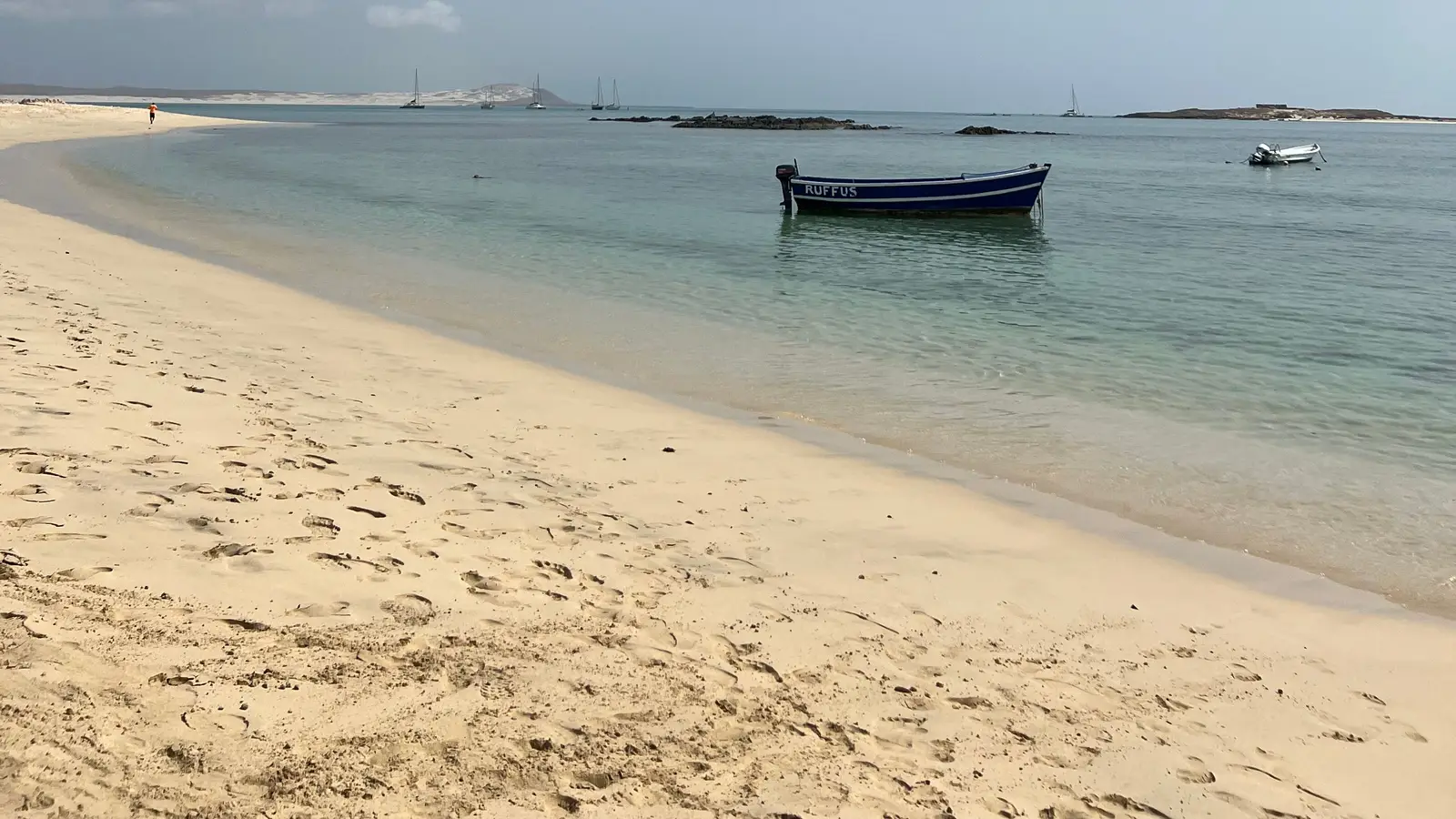
Sal took 58.5% of all hotel guests in 2024. In Santa Maria, the Ocean Café Hotel appears on BTC Map, the island’s only listing, so ask before you rely on it. Boa Vista, with 24.1% of guests, is resort country around Sal Rei and has no crypto listings. Fogo, Santo Antão, São Nicolau, Maio and Brava have a handful of bank branches each and no known crypto presence. There is no crypto ATM anywhere in the country. The islands hub lists banks and airports for each.
Top coins by local accessibility
Accessible here means easy to buy with a Cape Verdean card and easy to sell later. On that test, USDT, a dollar-backed StablecoinCripto ligada a uma moeda tradicional, como o dólar (USDT, USDC) ou o euro (EURC), para não oscilar de preço. Glossário, comes first: it is the coin in the few escudo P2P ads and the standard way to move value between exchanges. Bitcoin follows closely, listed everywhere and with four buy ads in escudos on Binance on the day we checked.
A third option makes unusual sense in Cape Verde: EURC, a euro stablecoin. Because the escudo is pegged to the euro, one EURC is worth roughly 110 escudos in theory, with no dollar exchange risk. Liquidity is thinner than USDT and not every exchange lists it. Ethereum, USDC, BNB, Solana and XRP round off the list. Our coins ranking orders them by accessibility, and the live escudo prices are in the table above.
Safety: wallets, scams and your seed phrase
An exchange holds the keys for you; that is a Custodial (custódia)A exchange guarda as chaves por si, como um banco guarda o seu saldo. Cómodo, mas depende da empresa. Glossário account. For small amounts you trade often, that is fine. For savings, a wallet where only you hold the Seed phrase (frase de recuperação)12 ou 24 palavras que dão acesso total à carteira. Quem as tiver controla o dinheiro; perdê-las sem cópia é perder os fundos. Glossário takes the exchange out of the equation. Write the words on paper, never in a photo or the cloud, and never share them, not even with “support”. One local quirk: Trezor does not ship to Cape Verde, while Ledger’s no-ship list does not include it, so confirm at checkout.
Scams reach the islands like anywhere else. “WS Investimentos” was sold as a crypto investment, promised to double or quadruple deposits of 50,000 escudos within a month, and collapsed, as Expresso das Ilhas reported on 21 December 2025. Nobody can guarantee fixed returns in crypto, and anyone who asks you to recruit friends is describing a pyramid. Our crypto scams guide lists the warning signs and where to report.
Where to start
Buying crypto in Cape Verde comes down to three choices: which card (Visa or Mastercard, not Vinti4), which exchange (CEX.IO as our main pick, Binance for P2P, Crypto.com or Kraken for SWIFT) and where to store it. Start with the fee comparison if cost matters most, the Vinti4 vs Visa guide if you do not yet have the right card, and the wallets guide before you leave a large balance on any exchange. If you live abroad and simply want to support family on the islands, compare an ordinary remittance first: a Western Union or Wise transfer can easily beat any crypto route.
Frequently asked questions
Can I buy crypto in Cape Verde?
Yes. Holding and buying crypto is not prohibited, although it is not legal tender. In practice you buy on an international exchange that accepts Cape Verde residents, paying with a Visa or Mastercard issued by a local bank or with a SWIFT wire. We found no exchange, OTC desk or crypto ATM based in the country.
Which exchange is best in Cape Verde?
In our test on 16 November 2026, CEX.IO came first: Cape Verde is on none of its restricted or no-card country lists, it takes Visa and Mastercard, and it has a European-Portuguese site. Binance is the pick for escudo P2P and Crypto.com for USD SWIFT wires. See the fee comparison for the numbers.
Does Binance work in Cape Verde?
It does. Binance lists 'Cabo Verde: Available' and its P2P market has supported escudos since March 2023. But on 16 November 2026 there were zero ads selling USDT for CVE, so on P2P you can only sell, at 7% to 20% below the official rate. To buy, a card is still the realistic route. More in our Binance review.
Can I use my Vinti4 card to buy crypto?
No. Vinti4 is the national debit network run by SISP and works at cash machines and card terminals inside Cape Verde, not on foreign websites. To pay an exchange you need a Visa or Mastercard (prepaid, Electron, Classic or Gold) with online payments enabled. Our Vinti4 vs Visa guide explains what to ask your bank.
Is crypto legal in Cape Verde?
Holding crypto is legal, but it is not legal tender, so nobody has to accept it. Law No. 30/X/2023, in force since 22 June 2023, requires anyone providing virtual-asset services in the country to register with the Banco de Cabo Verde first. We found no public register of providers. Details on our legal page.
Are there Bitcoin ATMs in Cape Verde?
We found no working crypto ATM on any island. BTC Map lists only four places that say they accept Bitcoin, one in Santa Maria on Sal and three on São Vicente, and those listings are self-reported by the businesses. Turning crypto into escudos happens through an exchange or P2P, with the money landing in a bank account, not a machine.
I'm on holiday in Sal. Can I buy crypto there?
Use the exchange account you already have at home; nothing on the islands replaces it. There is no crypto ATM on Sal and only one venue listed on BTC Map, in Santa Maria, which you should confirm at the counter. For everyday spending, euros are widely accepted on Sal and Boa Vista, but some shops use a rough rate of 100 escudos per euro rather than the official 110.265.
Fontes oficiais consultadas
- Boletim Oficial — Law No. 30/X/2023 of 21 June (BO I Série No. 68)
- Banco de Cabo Verde — alert on virtual currencies, 29 March 2018
- Banco de Cabo Verde — communiqué on Aviso No. 2/2024, 7 June 2024
- IMF — Cabo Verde 2023 Article IV (110.265 CVE/€ peg)
- SISP — Visa and Mastercard cards
- CEX.IO — Limits and commissions
- CEX.IO — Terms (CEX OVRS LLC)
- Crypto.com — USD deposits and withdrawals via SWIFT
- Kraken — geographic restrictions
- BTC Map — Cape Verde